
An afternoon with the Eames
Some people are so charismatic and captivating that their charm outlasts them. They make you wonder what it would have been like to meet them, to spend a whole afternoon in their company. For me, Charles and Ray Eames are one of those rare cases. Their story goes far beyond a romantic tale: it is a perfect example of a couple who kept their balance while driving their work forward, together.
Many remember them as a dynamic duo of designers, and the title is well deserved. They were a great team who built a rich career and left their mark across the design world. And like so many stories written when two different paths cross, theirs began by chance.
Charles (1907–1978) was born in St. Louis, Missouri, and started working in a printing shop at the age of ten. After discovering his father's photographs, he grew fascinated by photography and film. He studied architecture at Washington University, where he met his first wife, Catherine Woermann, with whom he had a daughter; the couple travelled to Europe for their honeymoon and spent it absorbed in the architecture of the places they visited. Back in the United States, Charles opened his own architecture studio with Charles Gray and Walter Pauley, and later founded another with his friend Robert Walsh. In 1939 he was invited to teach design at the Cranbrook Academy of Art, and a year later became director of the industrial design department. In May 1941 he and Catherine separated, and barely two months later Charles married Ray Kaiser.
Ray (1912–1988) was born Bernice Alexandra Kaiser in Sacramento, California, and her family called her Ray-Ray. Her gift for art showed early. In 1933 she began studying painting with Hans Hofmann, working with him until 1939, and she became a co-founder of the American Abstract Artists group in New York, where she held her first exhibition. After her mother died in 1940, she enrolled at Cranbrook, where she would cross paths with Charles for the first time and marry him the following year.
Their life together began with a scandal, though it was all but forgotten once you see the life they went on to build. From that point it becomes impossible to speak of one without the other: each was the other's creative catalyst. They kept their private life discreet, yet the harmony always shows in their photographs. I still smile remembering how one of my professors said, half joking and half serious, with a flicker of disbelief, that he had never seen a single picture of the two of them looking angry, only smiling. It's true. Those images radiate joy, whether they are at home in Pacific Palisades or simply out with friends. And it is that second scene where I let my imagination wander, and picture what it would have been like to share those moments with them.
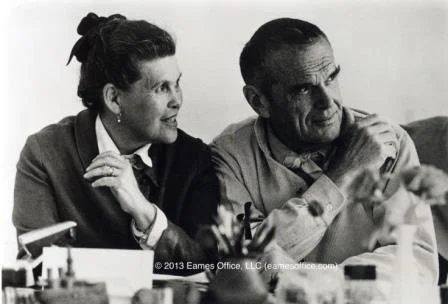
Ray & Charles Eames. © Eames Office LLC (eamesoffice.com)
Colour was, in many ways, the key to their work, alongside form the element always in the spotlight. They designed and built pavilions and furniture, produced short films, designed interiors, carried out house studies, manufactured parts for the US Navy during the war, organised exhibitions of art, photography and furniture, designed toys, and even produced advertising campaigns, among endless other things. The list seems to have no end. Still, three of them stir my curiosity most: their house, the little elephant, and one of their short films.
The famous Eames House in Pacific Palisades grew out of the home studies published in Arts & Architecture magazine in December 1945. It is Case Study No. 8, though the couple did not move in until 1949, onto a two-hectare plot shared with Case Study No. 9. At first sight the construction is simple: two levels, a main structure of steel frames, with vivid outer colours and materials neatly divided into panels of different sizes among the eucalyptus trees, all in perfect proportion. It is a spectacle of colour, and it reflects the care with which every element was chosen. Inside, decorative objects glow in the light pouring through the large windows. While Charles and Ray lived there, the house was in constant motion; everything changed place, and that was exactly the point. The idea was a space flexible enough to adapt to its inhabitants, and the Eames explored its full potential. Souvenirs gathered from around the world are still preserved inside, along with many pieces from their own furniture line. Those are the privileges of such passion and talent.
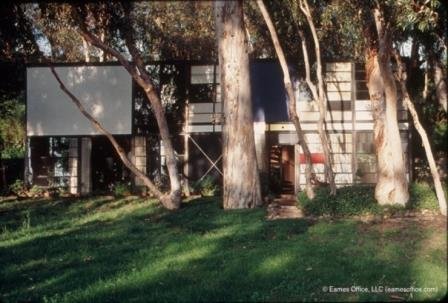
Case Study No. 8. © Eames Office LLC (eamesoffice.com)
I also love The Elephant. It caught my eye the very first time I saw it, and I could not believe it was a toy. I'll confess I still doubt that play was its original purpose. The fact that Charles and Ray had no children only fed that doubt, and it is such a neat, elegant object that it's hard to picture a child clambering over it. It was an experimental piece made of moulded plywood in 1945, and presented at a modern art museum the following year. Curiously, it was not actually manufactured until 2007, long after both had died, when Vitra produced it. That first edition reproduced the elephant in plywood in two finishes, red and natural, and later came the plastic versions you can find today in bright colours from Vitra or the Eames Office online store, versions that fill the toy's role perfectly. There is even a playful short film, made by Charles's grandson, in which this elephant is the star of its own small adventure.
But Charles and Ray were never only design. They went further, and film was part of their portfolio. One of them stole a night's sleep from me when I was a child: it made me think of how small we are against the vastness of the universe. That film was Powers of Ten, probably their best known. There are two versions: a black-and-white sketch from 1968, and the colour film it became in 1977. It carries you on a journey outward to the known limits of science at the time, and then back again. Even after all these years, the feeling it leaves still makes you think about the scale of things and stirs your philosophical side. And since pictures say more than a thousand words, you're better off watching it yourself.
After all this, there is no doubt how wonderful it would have been to spend an afternoon with this creative couple. We would surely find them bent over sketches for their next project, though I prefer the fantasy of a summer afternoon in California, in that house, sharing a lemonade with Charles and Ray. Happily, their legacy is in good hands: the Eames Foundation, led for years by Lucia Eames, Charles's daughter, and her five children, preserves and shares their work so it keeps its place in our shared culture and in contemporary design.
Links and recommended reading:
http://www.eamesoffice.com/
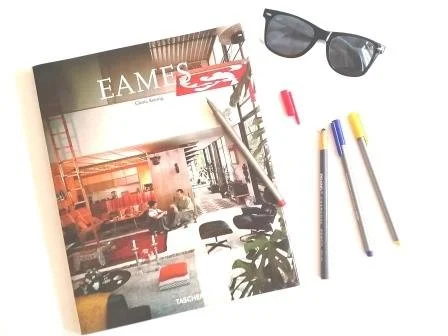
Koenig, Gloria. Eames. 2005, Cologne, Germany.
