
Ale Rambar | A call to "see and be seen" through art on paper
From the first moment I saw Ale Rambar's work, I was captivated. Not only by the beauty and the fine lines that the cut paper reveals as it tells a story, but by the subtlety with which it carries such a strong message. Understanding his work asks for nothing more than the viewer's own story and beliefs.
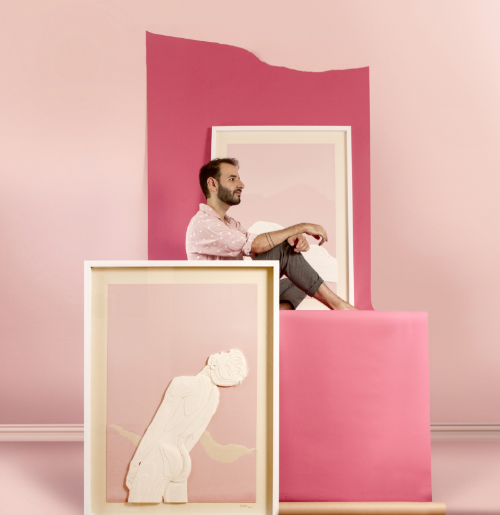
© Ale Rambar
In this conversation, Ale tells us what it was like to make the leap into an artistic life. He shares his motivations and the human side of his work, among many other things. It's an exchange that invites reflection while awakening curiosity and inspiration in equal measure.
Note: This conversation took place in May 2020.
Hi Ale. Could you tell us a bit about who you are and what you do?
I'm Ale. My stage name is Ale Rambar; my legal name is Alejandro, but I like using Ale because it carries no gender. I basically do two things. One is creating art pieces made of paper. The other is implementing designs in spaces, which is essentially environmental graphics, the middle ground between graphic design and architecture. But my main dedication is my work on paper.
We know you trained as an architect, yet you took the leap to devote yourself purely to art. Was that a difficult decision to make? What opened up this new perspective in your life?
I graduated from architecture school and later studied a range of courses, postgraduate programmes and diplomas in artistic creation, exhibition design and space design, all of them about people and their relationship with space, whether through colour, art or graphic line. What I love, as a person, is sharing ideas that help build community and bring people together through aesthetics.
And honestly, yes, it was a hard decision, and I'm still in the middle of it. I still have to move in and out of making a living from my art, mostly because of the pandemic right now. With the economy stalled, people aren't investing in art the way they did a few years ago, so I'm returning for the moment to work more focused on architecture and spaces. My goal has always been to dedicate myself fully to art, and I still hold on to that. This is only temporary.
I first decided to go one hundred percent into art around 2014. I was working in an office, keeping fixed hours and delivering projects to deadlines, the typical traditional setup, and the truth is I'm not someone who feels comfortable in that kind of environment. I like to feel a little freer. If I don't feel connected to a cause, a purpose or a social motivation greater than the work itself, it's hard for me to build the emotional bond that keeps me tied to a place. Through my art I started looking for ways to help people feel better, to feel visible rather than invisible, and all of this was shaped by what was happening in my own life.
I'm gay, and around that time things were beginning to shift in Costa Rica: many movements were opening up, and with them many people appeared pushing back against everything to do with sexually diverse people. I personally needed to see someone of my age, my time, my context, speaking about these issues from the point of view of a sexually diverse person. That's when I began my artistic career. Of course I was afraid to leave my office for something with more freedom, but I believe anyone who sets out to create something of their own has to go through that.
Not all of us are content spending our lives fulfilling someone else's dreams; some of us prefer to follow our own, and that is what I did. After thinking it through and watching how my pieces were selling, I worked out the best month to leave and handed in my notice. Then I started producing art full-time. Right now I'm at this midpoint, where I've decided to take a short break from art so as not to lose my footing as a space designer.
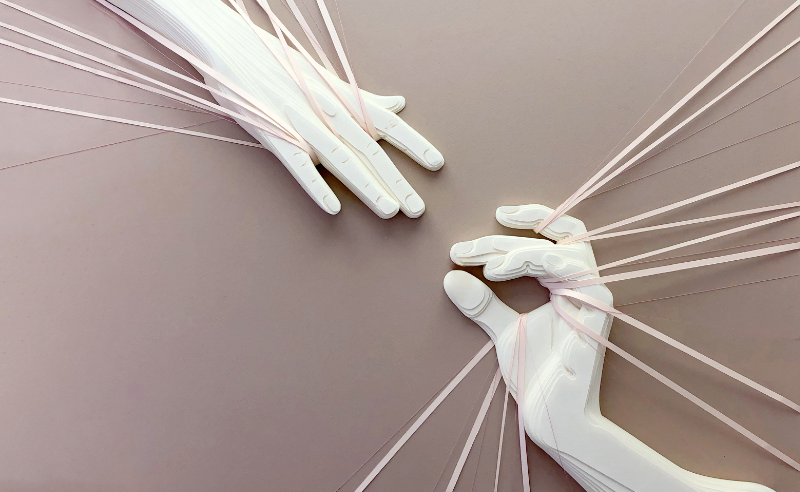
Almost There | 2019 © Ale Rambar
Let's talk about your work. Why did you choose paper and layers as your medium?
All my work on paper was born from architecture. I build my pieces the same way I once traced land contours at university. In architecture you're usually given a virgin site with topographic curves, like a natural mountain, and as you place the buildings you have to reshape the landscape, filling or excavating so that each structure fits. After analysing endless kilometres of topographic maps, building models, and studying which parts of the land were fragile, which were suitable for construction and which couldn't be built on at all, I began to wonder one day what would happen if I applied that same analysis to human bodies, taking it beyond architecture. That's how my work began.
I chose paper for several reasons. First, it lets me create very free, much looser shapes than I could with rigid materials; building in wood or plastic is difficult for me without technological processes involved, and I really like keeping tactile contact with my work. Paper is also a wonderfully humble material, within everyone's reach, everyone has at least one sheet of it at home at some point. So I started drawing a relationship between paper as an object and paper as a concept within the work itself.
In my pieces I deal with tolerance, respect and discrimination, subjects that run through our daily conversations and our reactions to the news. There's a conceptual link to paper because we handle it every day: we touch it, see it, read on it. We interact with it as a newspaper, a kitchen towel, a napkin, a piece of toilet paper. You simply decide whether to treat that paper as something worth keeping or something to let go. We do the same with discrimination. Some of us give it enough importance to say, "This can't keep happening," while many others let it pass like just another scrap of rubbish. I like making my work on paper to tell people: you already know this. You've already heard that you shouldn't discriminate, that you shouldn't write people off. And yet many let it happen anyway, just as they do with paper, letting it pass and pass again. The idea is that it stops.
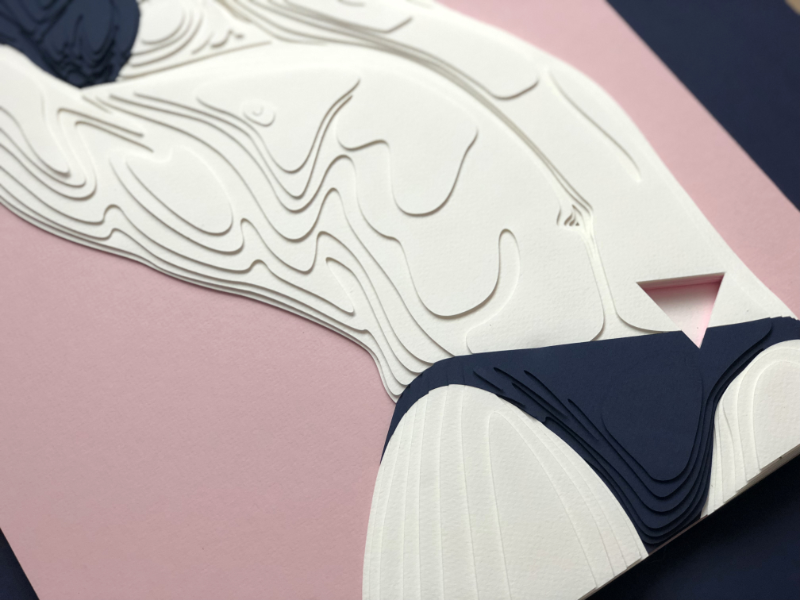
Identidad | 2018 © Ale Rambar
Other articles about your work mention how important it is for you to challenge the stereotypes and prejudices around masculinity. Some pieces show this explicitly, but I'd venture that this reflection is the central essence of almost all your work. Is that so? And how do you see your work as an opportunity to open that conversation?
The guiding axis of my work is tolerance. I draw that axis from ideas I've been unlearning since I was very young, as a Costa Rican, though the same happens to many people beyond Costa Rica; it's happening globally. So many ideas have been planted in our minds, from what our families tell us to what we see on television, very macho ideas that, at the end of the day, are deeply damaging to how we see ourselves: that men shouldn't cry, that men have to be strong, that showing emotion is a weakness, to name just a few. These are the ideas I like to question, so that they don't carry on.
The essence of my work and my exhibitions is to open a space for someone who has experienced discrimination, so that they realise someone else, somewhere, is going through it too, and that despite every difficulty things do flow and change. They get to see someone who is well, who is better after living through all of it. I try to show there is a light at the end of the road, even when it feels like society isn't on our side. If anyone has ever felt like less, felt undeserving, or believed they had fewer opportunities because of their sexuality, I want the work to show that this isn't the norm, that it isn't what happens to all of us. It matters to open up to the world and show that we have something positive to give. That's what motivates me, and why I like to open spaces for reflection and conversation, whether through my exhibitions or through the work itself.
"It is crucial to open up to the world and show that we have something positive to give, and at the same time show that there is a light at the end of the road."
Your work has appeared in exciting settings internationally, including China. What has it been like to reach such a large and diverse audience? And how do you think "cultural filters" shape the way your work is read?
Honestly, that's one of the things I find most fascinating about my work. I speak about things that are personal to me, things that happened to me, to my best friend, to people very close to me, and I've found that the more I talk about them, and the more contexts they appear in, the more people connect with them. Take exhibiting in China: it's a stricter culture than the Latin one, and even so, people came up to me saying, "That happened to me too."
The business of dolls, and the idea that boys shouldn't play with them, is relevant in many places. The same goes for saying women should have long hair, or that we all have to hide our emotions. These ideas are born from very specific contexts, but for me they're happening on a global scale, and that's what connects people. Some subjects are particular to certain realities, tied to the history of each place, but in general I've found the work has a level of universality that lets it function across contexts. That's because sexually diverse people exist everywhere, and so do more emotional men, men of every kind, and that only makes the work expand.
You've clearly built a path for your work and connected with your audience. Could you have imagined this impact when you took the leap? What would you say to the Ale of the past who was weighing that decision?
So many beautiful things have happened since I took the leap, along with plenty of demanding, testing experiences, and all of them make me feel it was one hundred percent worth it. When I jumped I was deeply insecure. I still had limits in how I expressed myself, and I was terrified to be gay in public; I think many people live that way, afraid to be who they are or to express themselves freely because their mind keeps replaying what society expects of them. Over time I've realised that the more transparent I am about my ideas, my messages and how I feel about the world, the more people connect and the further the message travels.
What I'd say to my past self is simply: don't be afraid. Be yourself, express yourself as you are, say the ideas that are in your head, because in the end many people will feel connected, and many need to see that others just like them exist. It happens that after an exhibition people come up to tell me how much it meant to see a gay person unafraid to say, "Yes, I'm gay, and this is what's happening in my life, in our country, in our context, and this is what I have to say about it." Maybe not everyone agrees, maybe some think differently, but at the end of the day what counts is representation: that they see someone who cares about these issues and speaks about them, so others know there's a light at the end of the road. That's what gives my work its value, and that's what I'd tell my past self. Don't be afraid.
There's surely much more we'd like to know about you and your work. Anything else you'd like to share?
I'd like to say that, in the end, examples are everything, at least for us as human beings. We see other people doing what we'd like to do, or carrying struggles we'd like to support, and that's how we feel identified and moved to help. So if you have a cause, an idea or a message to give the universe, the most powerful thing you can do is make it public. Make it visible. Your strongest tool is expressing yourself, exposing yourself, putting yourself out there to generate change, little by little.
And I'd add that I make all this work to support my community, to help it grow and come together, but it's also what I love doing and what I want for my life. If you support me, it helps us become more visible as a community, or as allies of the LGBT+ cause, and it helps me keep growing and carrying this message of tolerance forward. You can do that in many ways: by buying a piece, sharing the page, or passing it on to a friend.
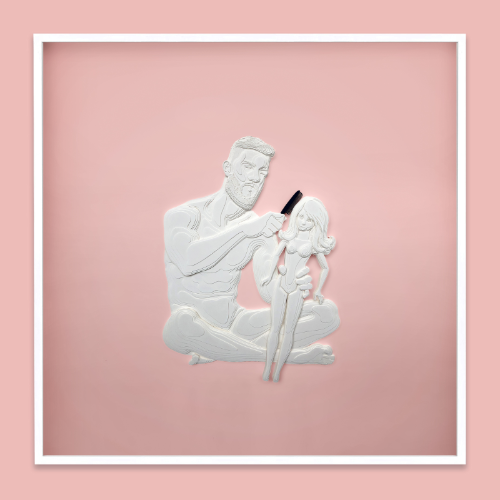
Jugando con muñecas | 2018 © Ale Rambar
Where can we find you?
Website and online store: alerambar.com
Instagram: @alerambar
Galleries:
Galería Artflow | Costa Rica
Galería Casa Escalante | Costa Rica
Galería EXTRA | Guatemala
New Gallery | China
Courses:
Domestika: a course where you can learn more about my work and the technique I use to shape my pieces. You'll learn how to make art with paper. I like helping people find their artistic voice, and if my method helps someone else grow, they're welcome.
Thank you so much, Ale, for sharing your story, your inspiration and your work with us.
_____
Where is Ale now? (July 2026)
Since this conversation, Ale's path has grown beyond his own practice. Today he co-leads Estudio Rambar, a contemporary art platform he founded with Gonzalo Solórzano, devoted to giving visibility to Costa Rica's creative talent. Representing more than a hundred artists across many disciplines, the studio works as a bridge between creators and projects, collaborating with collectors, architects, designers, hotels and companies to carry the country's art to new audiences at home and abroad.
You can find Estudio Rambar at estudiorambar.com
